
SEO & AEO
Don’t Rebuild SEO for AI. Fix the Fundamentals First.
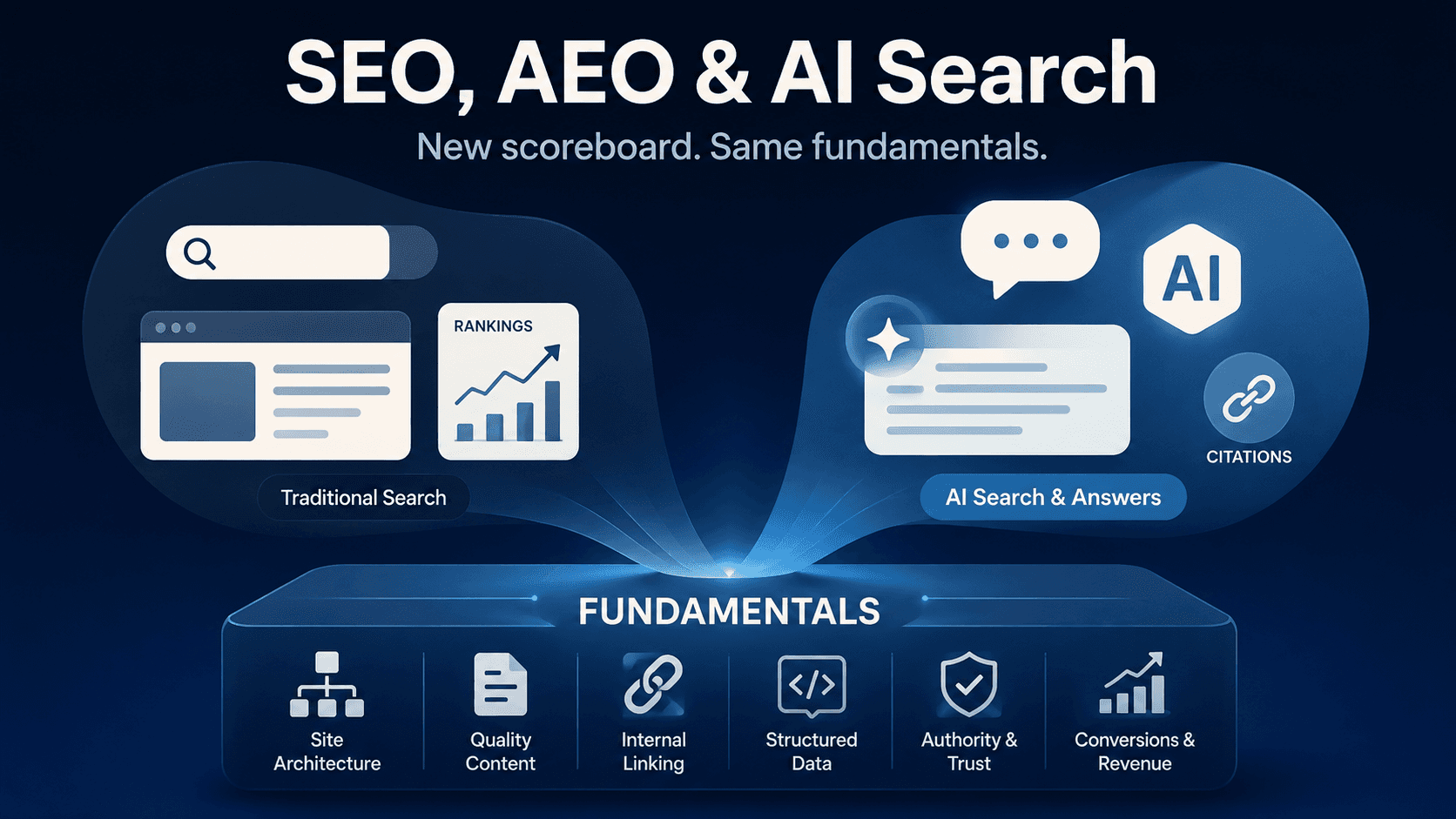
AI search changes the scoreboard. It does not replace the fundamentals of doing good SEO.
Core thesis: AI search changes the visibility layer and the measurement stack. It does not replace the fundamentals: crawlability, architecture, intent-led content, topical depth, trust, internal linking, schema hygiene, and revenue-backed measurement. |
Every few years, SEO gets declared dead. Then it quietly becomes more important.
Right now, the panic has a new name: AI search, AEO, GEO, ChatGPT visibility, Perplexity citations, AI Overviews, and zero-click answers. The surface is changing, no doubt. The way people discover information is changing. The way search engines present answers is changing. The metrics we use to measure visibility will also change.
But the fundamentals of doing good SEO are not being replaced. That is the part getting lost in the noise.
Brands are being told to rebuild their entire SEO strategy for AI. New frameworks, dashboards, tools, and “AI visibility hacks” are showing up every week. Some of that will matter. Most of it is premature. The better way to look at this is simple: SEO is not being replaced by AEO or GEO. The scoreboard is changing. The implementation system is not.
You still need pages that can be crawled, understood, trusted, cited, and acted upon. You still need strong content, clean architecture, internal linking, topical depth, technical hygiene, structured data where relevant, and authority signals that prove your brand deserves to be surfaced. That was true before AI search. It is even more true now.
The Goal Was Never Just Rankings
There is a trainer at most gyms who has been there for twenty years. Back in the day, he would put you on a scale, look at the number, and hand you a plan: lose 10 kg. That was the whole measurement system. Nobody questioned it because nobody had anything better. The goal was always right — be healthier, live longer, move better, perform better — but the measurement was blunt.
Today, the same trainer has access to DEXA scans, VO2 max tests, HRV monitors, glucose trackers, sleep data, and recovery data. The goal has not changed. What changed is that we got much better at understanding what actually moves the person toward the goal.
SEO has followed the same path. For years, we used the bluntest possible measurement system: keyword rankings. Then came traffic, engagement, conversions, assisted revenue, topical authority, E-E-A-T, Core Web Vitals, brand demand, featured snippets, zero-click visibility, and now AI mentions and citations. Every phase made the scoreboard more sophisticated, but the goal was always the same: get people with real intent to find you, trust you, and take action.
That is SEO. Not rankings. Not traffic. Not impressions. Those are useful markers, but they are still markers. The business outcome was always the real goal.
How SEO Measurement Evolved
In the early days, SEO was measured like an old-school gym weigh-in. You picked a keyword, tracked where you ranked, and called it a win if you hit page one. Traffic became the second big number. Sessions, users, pageviews — the bigger the number, the better the SEO looked.
It worked for a while because search was simpler. But the cracks were obvious. A page could rank number one and still drive no business. A blog could bring in thousands of visits from people who would never buy. A content calendar could look successful in Google Analytics and still contribute nothing to pipeline. The scale said you were lighter, but it did not tell you whether you were healthier.
Then Google got better at understanding searchers. Updates like Panda, Penguin, and Hummingbird pushed SEO away from keyword stuffing and closer to usefulness, relevance, and intent. Suddenly, ranking for a term was not enough. You had to ask what the person actually wanted: were they trying to learn, compare, buy, troubleshoot, find a brand, or evaluate options?
This is when search intent became central to SEO. Informational, navigational, commercial, and transactional searches needed different page types. The same keyword could mean very different things depending on where the user was in their journey. A page could rank well and still fail because it matched the keyword but missed the intent.
Then SEO became even more layered. Google was no longer evaluating only individual pages. It was evaluating brands, authors, topics, trust signals, user experience, and the overall quality of a site. E-E-A-T forced teams to think beyond content volume. Topical authority changed the unit of SEO from individual pages to clusters. Core Web Vitals added the experience layer: LCP, INP, and CLS.
The goal did not change. Google was still trying to serve the most useful result. But the definition of useful became broader. Useful was no longer just about matching the keyword. Useful meant the page was relevant, trustworthy, complete, fast, accessible, and part of a larger body of reliable content. That is where SEO was already headed before AI search became the loudest topic in the room.
What AI Search Actually Changes
Now the search surface is changing again. Google is answering more questions directly on the results page. Featured snippets, People Also Ask, Knowledge Panels, and AI Overviews can satisfy users before they click. ChatGPT, Perplexity, Claude, Gemini, and other AI assistants are also changing how people discover information.
Instead of showing ten blue links, these systems often synthesize an answer. Sometimes they cite sources. Sometimes they mention brands. Sometimes they use the language, framing, and facts from existing web content without sending the same kind of traffic that traditional search used to send.
This is why AEO and GEO have become popular terms. Answer Engine Optimization is largely about becoming the answer. Generative Engine Optimization is largely about being trusted and cited in AI-generated responses. These are useful concepts, but they should not become distractions. The work required to win here is not some completely separate discipline.
AI search does not remove the need for SEO fundamentals. It raises the bar for them. If your site is hard to crawl, AI search will not save you. If your content is thin, disconnected, generic, or untrusted, AI search will not save you. If your page does not answer the query clearly or your site has no conversion path, AI search will not save you.
This is why rebuilding SEO for AI is the wrong framing. The better framing is: build fundamentally strong SEO, then layer AI-search requirements on top of it.
What Does Not Change
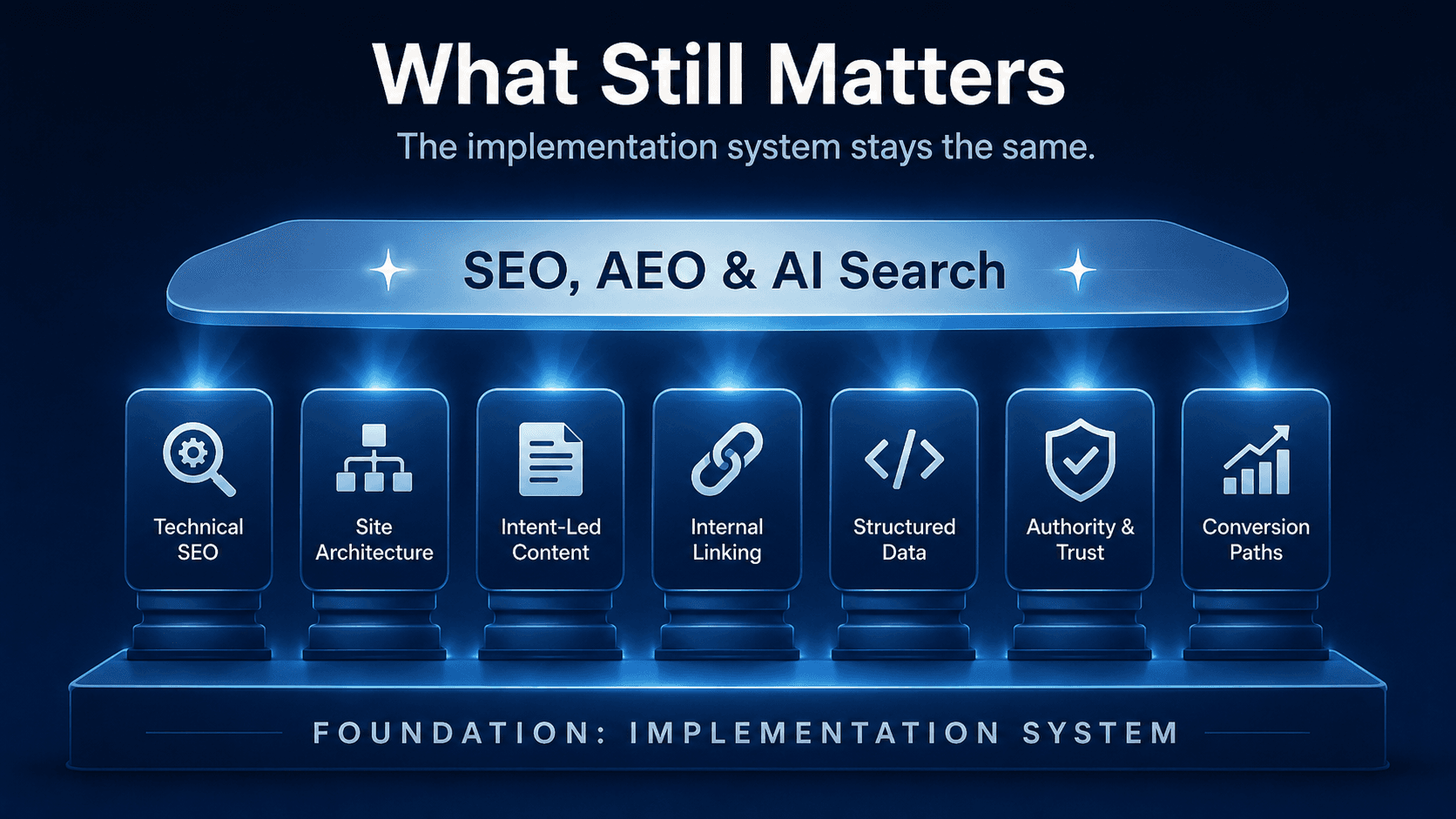
A lot will change in how we measure SEO, but the implementation muscle remains the same. You still need clean technical foundations because search engines and AI systems cannot use what they cannot access, crawl, render, or understand. Your pages need to be indexable, your important content needs to be available in text, your templates need to be clean, and your site should not make machines work unnecessarily hard to understand what matters.
You still need strong information architecture. AEO and GEO do not make site structure irrelevant; they make it more important. If your content is scattered, duplicated, cannibalized, or poorly linked, you are making it harder for both users and machines to understand your expertise. You still need intent-led pages because a beginner looking for “what is CRM” and a buyer searching for “best CRM for real estate teams” do not need the same page.
You still need topical depth and trust. Thin content is becoming less defensible. Stronger content clusters, better page depth, real examples, original insights, clear internal linking, author bios, expert review, primary data, case studies, customer proof, brand mentions, third-party citations, and clear ownership all matter. Not because they are hacks, but because they help prove that your brand deserves to be trusted.
You still need structured data where it makes sense. Schema is not magic, and it will not automatically get you AI visibility. But it is useful hygiene when implemented correctly and honestly because it helps search engines understand the entities, authors, products, FAQs, reviews, breadcrumbs, and relationships on your site.
You still need content that answers clearly. Answer-first formatting is not just for AI; it is better for humans too. When someone lands on a page, they should not have to scroll through 800 words of setup before getting the basic answer. Clear definitions, summaries, tables, bullets, examples, and FAQs all help.
Most importantly, you still need to measure revenue. The job is not to rank. The job is not to get mentioned by an AI tool. The job is to create profitable organic demand. If traffic, rankings, snippets, and AI citations do not help the business create pipeline, leads, signups, demos, customers, or revenue, the program is incomplete.
What Will Change

The metrics will change, and that part is real. Keyword rankings will still matter, but they will not tell the full story. Organic traffic will still matter, but some informational queries may get answered before the click. CTR will still matter, but it will need to be interpreted differently depending on the SERP layout.
Featured snippet ownership, People Also Ask visibility, brand mentions in AI-generated answers, citations in tools like Perplexity, presence in AI Overviews, branded search volume, direct traffic, and share of voice across traditional search and AI search will all become more important. But revenue influenced by organic should remain the north star.
The SEO dashboard of the future will look different from the SEO dashboard of 2015. But the dashboard is not the strategy. It is just the scoreboard. And when the scoreboard changes, you do not throw away the sport. You improve how you play it.
The Right Response
The wrong response is panic. The wrong response is throwing out your SEO roadmap and replacing it with AI hacks. The wrong response is chasing every new acronym without fixing the basics. The wrong response is asking, “How do we rank in ChatGPT?” before asking, “Do we have the best page on this topic?”
The wrong response is adding schema to weak content and expecting magic. It is tracking AI mentions before your product pages, comparison pages, integration pages, and use-case pages are properly built. This is where a lot of teams will waste time: they will chase the new layer before fixing the foundation, build dashboards before building authority, and buy tools before fixing templates.
The right response is boring, which is usually where the money is. Fix your architecture. Clean your templates. Map your core categories. Define your page types. Build pages for real intent. Create content that is actually better than what already ranks. Add original data, examples, expert input, and product context.
Use schema where it genuinely helps. Strengthen internal linking. Consolidate cannibalized pages. Improve page experience. Build authority outside your website. Track rankings, traffic, snippets, AI visibility, and revenue together. Do not separate SEO and AEO into two disconnected programs. Do not treat GEO as a magic new department. Treat AI search as another visibility surface that sits on top of the same fundamentals.
That is the practical path. Build fundamentally strong SEO first, then top it up with AI-search requirements. Not the other way around.
The Hype Will Change. The Work Will Not.
The trainer with a scale was not completely wrong. Weight did matter. But weight alone was never the full picture of health. The trainer with a DEXA scan, VO2 max test, HRV tracker, and glucose monitor has a much better view of what is actually happening. Fitness did not change. The measurement caught up.
SEO is in the same place. Rankings still matter and traffic still matters, but they are no longer enough. Search has become more complex. Discovery has become more fragmented. AI systems are changing how answers are assembled and presented. Users are consuming information differently. So yes, the scoreboard needs to evolve.
But the work remains deeply familiar: build useful pages, structure knowledge properly, make your site easy to crawl and understand, earn trust, answer clearly, show real experience, build authority, and connect content to revenue.
That is what worked before AI search. That is what will work inside AI search. The brands that win the next version of search will not be the ones chasing every new acronym. They will be the ones doing the old work better. The hype will keep changing names. The fundamentals will not.
Contact
Let’s talk about growing your revenue, not just your traffic.
Exploring SEO, fractional help, or an audit? Let’s talk.